
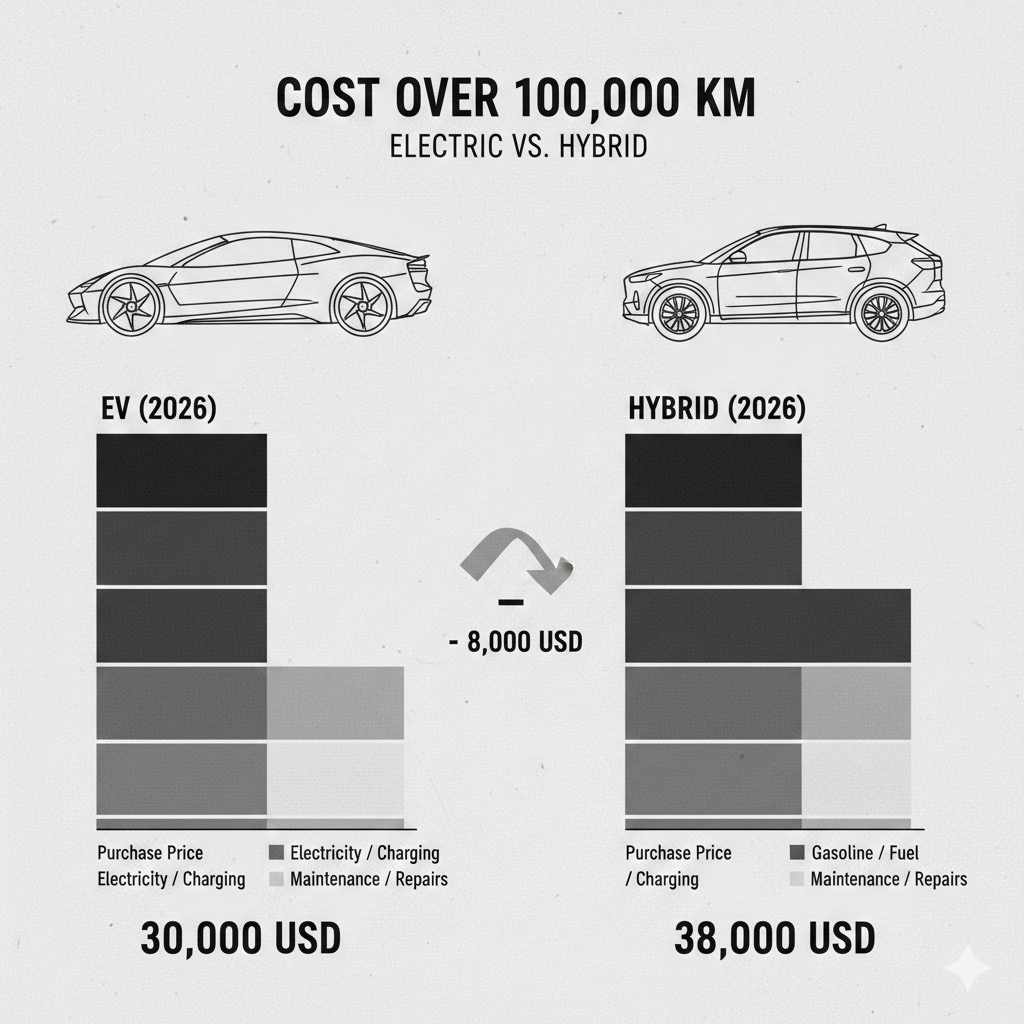
As we advance into 2026, the automotive landscape is rapidly evolving, with electric vehicles (EVs) and hybrid electric vehicles (HEVs) dominating discussions around sustainable transport. Both offer compelling advantages over traditional internal combustion engine (ICE) cars, boasting lower emissions and often integrating cutting-edge advanced driving assistance systems (ADAS) and a suite of convenience features available through subscriptions. However, for prospective buyers, the ultimate decision often boils down to the “Total Cost of Ownership” (TCO) over the vehicle's lifespan. This article delves into a comprehensive TCO comparison between a mid-range EV and a comparable hybrid over a typical ownership period equivalent to 100,000 kilometers (approximately 62,137 miles), providing a clearer financial picture for 2026.
Initial Purchase Price and Incentives
The sticker price remains a significant differentiator. By 2026, while EV prices are trending down, they generally still command a premium over equivalent hybrid models. However, government incentives can significantly offset this. Many regions continue to offer tax credits or rebates for new EV purchases, which can bridge a substantial portion of the price gap.
- EVs: Typically higher upfront, ranging from $40,000 to $60,000 for a mid-range sedan or compact SUV, potentially reduced by federal or state incentives.
- Hybrids: Generally more affordable, with comparable models often priced between $30,000 and $45,000, with fewer widespread incentives specifically for HEVs compared to pure EVs.
Fuel/Energy Costs Over 100,000 km
This is where EVs typically shine, assuming a robust home charging setup. Electricity prices are generally more stable and lower per “mile of range” than gasoline prices. However, reliance on public fast chargers can elevate EV energy costs.
- EVs: Home charging is the most cost-effective. Assuming an average electricity rate of $0.15 per kWh and an efficiency of 3.5 miles/kWh, covering 100,000 km (62,137 miles) would require approximately 17,753 kWh, costing around $2,663. Occasional public fast charging will increase this average.
- Hybrids: While more fuel-efficient than conventional ICE cars, hybrids still run on gasoline. Assuming an average fuel economy of 40 MPG and a gasoline price of $3.50 per gallon, covering 100,000 km would require approximately 1,553 gallons, costing around $5,435.
Maintenance and Repairs
Electric vehicles benefit from fewer moving parts, leading to simplified maintenance routines. Hybrids, while having some EV advantages, retain the complexity of a gasoline engine.
- EVs: No oil changes, spark plugs, or complex exhaust systems. Less wear on brake pads due to regenerative braking. However, specialized EV tires may wear faster and cost more. Potential for ADAS sensor recalibration and software-related diagnostics. Estimated maintenance for 100,000 km: $2,000 - $3,500.
- Hybrids: Still require regular oil changes, filter replacements, and spark plugs. While regenerative braking helps, they still have conventional brake systems that need maintenance. The added complexity of two powertrains can sometimes lead to specialized repairs. Estimated maintenance for 100,000 km: $3,500 - $5,000.
“By 2026, the long-term cost savings on fuel and maintenance are increasingly positioning EVs as a more economically sound choice over their hybrid counterparts for many drivers.”
Insurance and Other Costs
Insurance premiums for EVs can sometimes be higher due to the higher initial purchase price and specialized repair costs for advanced battery systems and electronics. Both vehicle types will likely incur similar costs for ADAS subscriptions or advanced infotainment features.
- EVs: Insurance often slightly higher due to vehicle value and repair specifics. Tire replacement costs can be higher due to specialized low-rolling-resistance designs and heavier vehicle weight.
- Hybrids: Insurance typically more in line with conventional vehicles. Tire costs are generally standard.
TCO Comparison Table (100,000 km in 2026)
Here’s an illustrative breakdown of the estimated Total Cost of Ownership over 100,000 km for comparable mid-range models in 2026:
| Cost Factor | Mid-Range EV | Mid-Range Hybrid |
|---|---|---|
| Initial Purchase Price (Net) | $45,000 | $35,000 |
| Fuel/Electricity Costs | $2,700 | $5,450 |
| Scheduled Maintenance & Repairs | $2,500 | $4,200 |
| Tires (Replacement) | $1,500 | $1,000 |
| Insurance Premiums | $6,000 | $5,000 |
| Estimated Total Cost (100,000 km) | $57,700 | $50,650 |
Note: These figures are illustrative and can vary significantly based on vehicle model, local market conditions, driving habits, and available incentives. They do not include ADAS subscription costs or potential resale value, which also factor into a full TCO analysis.
Beyond the Numbers: Qualitative Considerations
While the hybrid may appear to have a lower TCO over 100,000 km in this scenario, the EV offers other advantages:
- Driving Experience: EVs provide instant torque, silent operation, and a smoother ride.
- Environmental Impact: Zero tailpipe emissions for EVs, significantly lower for hybrids.
- Charging Convenience: The ability to “refuel” at home overnight with an EV is a major convenience for many.
- Technological Edge: EVs often integrate more deeply with smart home systems and are at the forefront of automotive technology by 2026.
Conclusion
By 2026, the choice between an EV and a hybrid for a 100,000 km ownership period involves a nuanced financial calculation. While hybrids often retain an edge in initial purchase price and potentially overall TCO for this specific mileage target, EVs offer substantial savings in fuel and maintenance, along with a superior driving experience and environmental benefits. The rapid pace of EV development suggests that their TCO could converge with or even surpass hybrids in subsequent ownership periods. To make the most informed decision tailored to your specific needs and driving patterns, it is highly recommended to use a "Total Cost of Ownership" (TCO) calculator.